
0
"Intelligence in testing" has become one of the most spoken conversations in enterprise software, and the phrase now covers very different things: models that generate test scripts, models that estimate probabilities, and systems that operate strictly with rules.
In this newsletter, we will focus on the last group, called deterministic intelligence, and why we think it suits payment testing so well. It is also the approach behind something we launched recently, which we will discuss later below.
A deterministic system applies a set of fixed rules to the evidence in front of it, so the same evidence always leads to the same conclusion.
Ask about the same failure tomorrow, or have two different test engineers run it, and you get the same answer and reasoning.
A probabilistic model behaves differently as it learns from patterns and offers a good estimate that can shift as the data changes. Both have a role in software, but they behave very differently when you need to defend a test result.
The second property is that a deterministic system can display how it works.
From reading the data to comparing values to concluding, the process can be laid out in order and inspected. If you agree or disagree with a result, you can see exactly what you agree or disagree with, and you can hand the same pivot to a colleague or an auditor without reconstructing how you got there.
Deterministic intelligence works best where the rules are already known, and payments is one of the closest entities to apply it. EMV specifications, mandated by the payment network, certification test plans, and message formats such as ISO 8583 define correct tag-, bit-, and byte-level behavior.
When a test case has a pass criterion, the expected answer exists before the test runs, so a system can work out what a value should have been and compare it with what the logs contain.
Certification also raises the cost of ambiguity, because a lab, a terminal vendor, an acquirer, and an issuer will always want to know why a test failed.
"The model might think it is probably the terminal," which is hard to defend, while "this tag carried this value, and the specs require that one, and here is where they differ" is much easier to act on.
A test case will have many pass criteria. If any test case fails in EMV Level 3 certification, the tester usually starts by finding the relevant tag in a raw hex log, nested several levels deep.
Next, they determine whether the terminal, the card, the host, or the test setup is responsible. If a cryptographic check such as an ARQC is involved, they would repeat the calculation by hand to rule out a key or certificate issue. In the end, they write an explanation for whoever needs to act.
This manual process depends on scarce EMV expertise, and the write-ups it delivers vary from one tester to another. It is also repetitive because a single underlying problem can cause several test cases to fail, and teams often only discover that as they hit each failure one by one.
Because the rules are known, the system can handle most of the routine work.
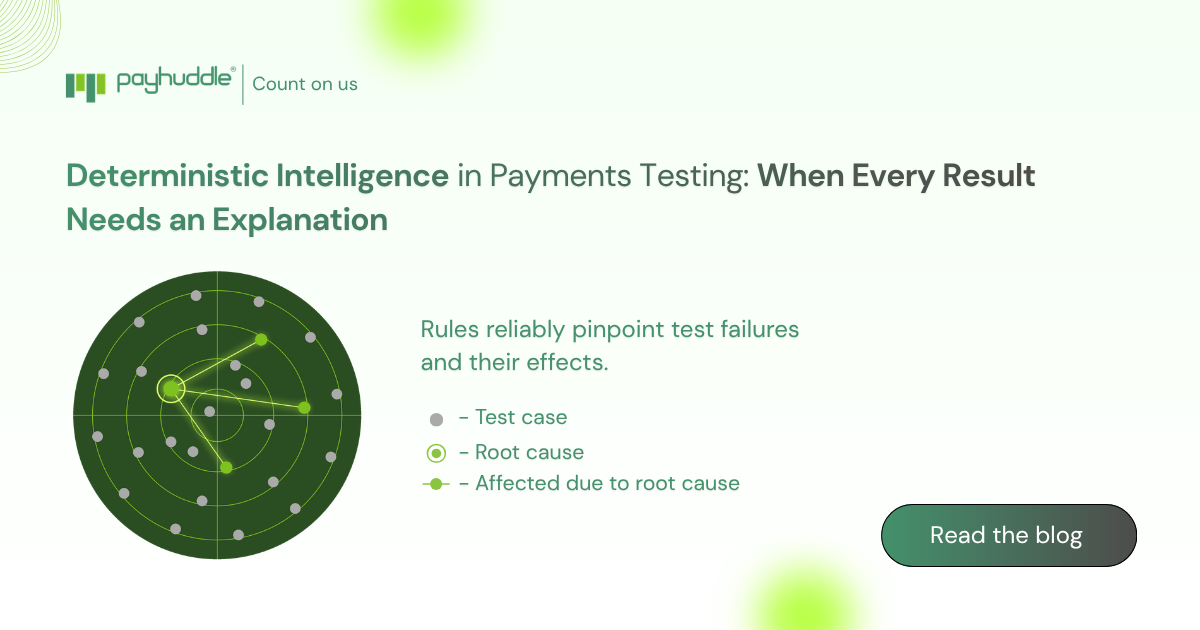
Attribution identifies where a failure starts, be it the terminal, the card, the host, or the test setup, and explains the cause in plain language with a recommended fix. It helps the tester start in a clear direction rather than with raw logs. Propagation finds across the test suite and identifies other test cases likely failing for the same root cause so that you can validate one fix across all of them.
It removes the repeated analysis that usually follows when you come across the same problem several times. Cryptographic verification shows why this approach works well.
The system can run the calculation itself and show all the inputs and intermediate values, so you can tell whether the fault lies in a key, an input, or the computation by looking at the numbers.
Consistency checks at the start help, as they confirm that the card log, host log, and terminal configuration agree. It catches setup mismatches that look like product defects, which are among the most frustrating failures to find by hand.
What we discussed above happens behind Tecto Intelligence, built into Tecto, our EMVCo- and network-qualified EMV Level 3 test tool.
When a test fails, it reads the same card and host logs a tester would, applies the certification rules, identifies the issue, explains the root cause, recommends a fix, and points to other affected test cases.
The reasoning stays visible throughout, so you can share the diagnosis with a terminal vendor, acquirer, or issuer without a long conversation about how you located it.
We launched Tecto Intelligence at Global Fintech Fest 2026 and have been genuinely excited by how it was received, by the wider audience at our booth and by our existing partners.
Our CEO, Prakash Sambandam, did the launch, and this is what he said: "You've seen it at our booth: not all intelligence is artificial; some of it certifies payments. That's exactly what we're launching today. The real challenge in terminal testing was never knowing whether a terminal passed or failed. It's finding out where the issue actually is: the terminal, the card, or the host.
We're the first to bring a product to market that identifies exactly who's at fault. And we've built it on deterministic intelligence, not generative. That means the answer is consistent every time, and never a guess. This is just the first step. Attribution tells you where the fault is. Propagation tells you what else it affects, so you're not re-testing the same root cause fifty times over."
Tecto Intelligence is currently implemented for the Discover network.
As a deterministic system is only as good as its rules, we would rather build each network properly.
Next, we plan to extend it to other networks and to bring the same approach to our other core products, Tropo and Lithos.
In Tropo, our qualified test tool that validates card personalization, and in Lithos, which supports host testing and debugging, a simple, validation-ready explanation is what is needed for faster certification. As Prakash said, this is only the first step, and we will share more as that work progresses.
Not every testing problem needs a model that learns from the past.
Where specifications are known, and certification depends on following them exactly, a system that applies the rules consistently and shows its reasoning can be more useful than an estimate.
For payments, this powerful combination of consistency and transparency makes intelligence trustworthy enough to rely on.

.png)


