0
This blog is about something most payment teams experience but doesn't name it directly. The certification pipeline is slow. Not because the networks made it slow. Because the way teams run it hasn't matched up with what they're being asked to certify.
Level 3 testing is completely standardized. Visa's L3 Certification Framework, Mastercard TIP, Discover E2E, and JCB TCI define exactly what will be evaluated. The test cases are documented, and the acceptance criteria are clear. The networks have handed the test teams a structured, repeatable specification to work from.
What they haven't handed teams is an operational model for executing it.
The frameworks define the floor.
What gets built on top of that floor - how tests are actually run, tracked, diagnosed, and reported - is entirely up to the team. And for most teams, what's been built on top looks like a combination of manual effort, disconnected spreadsheets, and tribal knowledge held by two engineers who are already overloaded.
That gap is where the scale stops.
Teams aren't certifying a single terminal for a single network. They're managing multiple network test suites simultaneously, across different terminal models, vendors, and geographies.
Visa, Mastercard, and local networks on the same hardware, running in isolation from each other, with no shared framework tying them together.
When a test fails, the diagnosis is done manually.
Technical teams extract card and terminal communication logs from personalized test cards, retrieves network logs from simulators, and checks them line by line to identify specific data-element errors. Engineers become data parsers. The time cost increases, and it compounds across every failed case in every test run.
The execution itself adds more dead time. Even though the network predefines the test cases, a tester still has to manually select a case, execute it, wait, analyze it, and click forward to the next one. Between each step, the clock is running. Over a full certification cycle, that dead time adds up to days.
And then there's project portfolio tracking to track which terminal is certified for which kernel? Where regression testing stands. Whether the final report is ready for submission. In most teams, that information lives in someone's inbox, a shared spreadsheet, or a ticketing tool that wasn't designed for any of this.
At low volume, it's manageable.
During scaling, it breaks.
Going from certifying one terminal at a time to handling fifty concurrently doesn't require any testing. The networks have already defined that. It requires changing how the testing is executed and managed.
That means:
None of those changes touch the test cases. They remove the friction around them.
Tecto, our L3 test platform, is built on exactly this principle - a standardized operational layer sitting directly on top of network frameworks, automating the parts that are currently slow: real-time log validation, automated host log retrieval, semi-automated card log retrieval, and automatic report generation ready for card brand submission.
Tooling is only part of it. The teams operating most effectively have made a few structural decisions that go beyond the tool itself.
Cross-skilling the testing team so that any tester can run any network's test suite, not just the one they were originally trained on, removes the bottlenecks that form when specialists are the only ones who can execute a given workflow.
Running a strict internal smoke test before any terminal enters the official L3 certification queue prevents engineers from spending lab time on builds that were never ready in the first place.
A short baseline check, run internally, catches broken builds before they go for certification slots.
Tracking in a live centralized dashboard directly connected to the test tool output eliminates spreadsheet maintenance and provides a real-time view of certification status across projects.
Using detailed log data as evidence when the terminal application fails and exporting those reports directly to vendors reduces the debugging cycle from weeks to days.
This kind of optimization directly affects how quickly a terminal reaches final submission.
Getting the certification letter on the first iteration, rather than the third, is not a small thing when lab slots are limited and mandated deadlines are strict.
With the right tools in place, self-certification moves faster, functional testing across hundreds of UAT test cases runs in minutes rather than days, and the environment is reproducible enough that results are consistent across every run.
Custom test cases further extend what's possible without waiting on external dependencies.
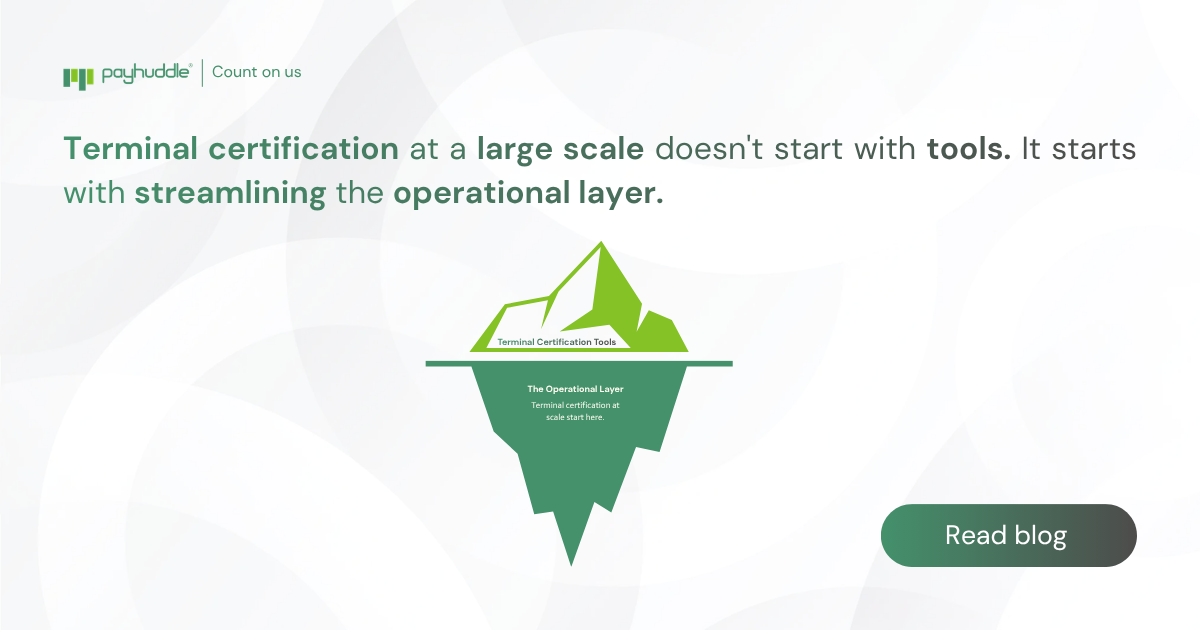
The networks provided teams with a standardized definition of what certification entails. The missing piece, the one that determines whether a team can certify at scale or is perpetually catching up, is the operational layer sitting on top of that definition.
Building that layer is no longer optional. The volume of terminals, kernels - especially C-8 co-existing on top of the network-specific kernel, and networks in play in 2026 makes the manual model structurally unable to keep up.
The teams that recognized that early are already running differently.