0
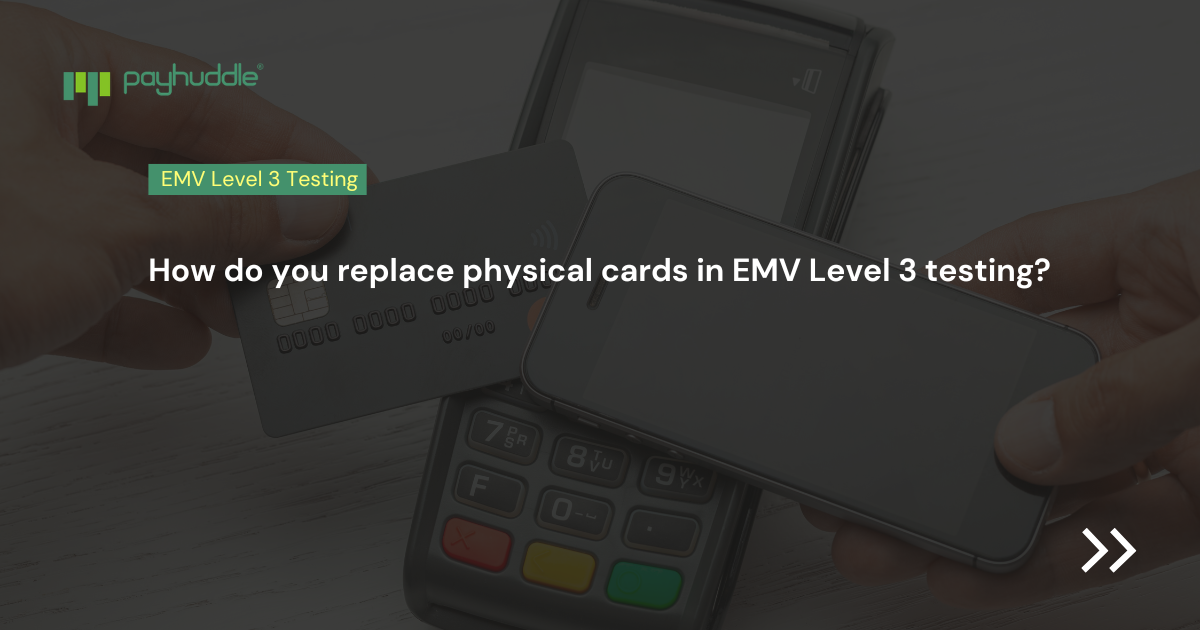
You buy a test tool, which comes along with a bunch of physical test cards that you use for your testing, both contact and contactless test cards.
It is a massively cumbersome process for test tool vendors, who must ship the product dongle along with a large number of test cards covering all test cases.
You will also have to maintain an inventory of these cards. Besides, if there are any defective cards, you will have to replace them, which is time-consuming.
EMV card replacement during testing has been a persistent operational challenge for acquirers, processors, and terminal vendors alike. Every card in the inventory represents a potential point of failure. A scratched chip, a demagnetized stripe, or a card that goes missing between test cycles can stall an entire certification project while a replacement is sourced and shipped.
Alternatively, the tool vendor provides programmable cards and a soft card library. Here, you are dependent on readers to program and capture the logs. It can hurt your testing and certification.
How do you get out of this cumbersome process?
This is where card personalization and simulation using a mobile app come into play. With this, you can avoid sending physical test cards and hardware dependency. Once you remove this dependence, you can efficiently perform your EMV Level 3 testing across payment networks.
Virtual card EMV L3 testing removes the physical card entirely from the scene. Instead of managing an inventory of plastic cards that degrade, are lost, or require replacement, the test card is a software profile that can be personalized, reconfigured, and reused.
The idea is to use an Android phone as the test card. You download the mobile application and use it to personalize the card. Tap the phone to the terminal to process E2E certification test cases. This is called App Card Personalization. For contactless transactions, you can directly tap the phone to the terminal.
Contactless virtual card EMV testing conducted this way behaves exactly as a physical contactless card would from the terminal's perspective, while giving the tester complete control over the card profile without needing a different physical card for every test scenario. A single Android device can represent dozens of different card configurations simply by reloading the profile in the app.
Tap a physical card on an Android phone to load the profile onto the test card via NFC. Here, you tap the card on the phone and personalize it so that the card can be used to tap on the terminal to process E2E certification test cases. This is called App Card Simulation.
You only need a mobile application to store card profiles, personalize, and simulate app cards.
Soft card EMV certification through this model means the certification process itself does not need to account for physical card logistics as a project dependency. A terminal vendor preparing for certification no longer needs to request a specific card set from a test tool vendor and wait for shipment. The card profiles are already available in software, ready to be loaded and used the moment testing begins.
Once testing is complete, your test tool can access and analyze the mobile app's logs to validate the results and issue the certification.
Imagine having your test tool on the cloud; that would ease your testing tremendously. We would take that up separately as another blog on cloud delivery of test tools.
We come across many use cases, such as smart ticketing and low-value payments, where only contactless readers are used, not dual-interface readers.
In these scenarios, testing becomes very simple because your mobile app can serve as both the card and log-capturing app. You don't have to simulate the cards at all.
Software card EMV L3 testing has particular advantages in these contactless-only environments. Because there is no need to account for a contact interface, the test setup simplifies to a single mobile application interaction, removing an entire category of physical hardware from the testing process.
NFC-enabled devices are driving innovation in payment testing and certification. With these applications, you can reduce plastic and carbon footprints. This is only the tip of the iceberg for NFC-enabled devices, and many more use cases can be imagined with NFC's power.
EMV virtual test card adoption also brings a sustainability benefit that is easy to overlook in a purely technical evaluation. Every physical test card that a virtual alternative replaces is one less piece of plastic manufactured, shipped, and eventually discarded. For test tool vendors and their customers running certification projects across multiple markets and multiple terminal models, that reduction adds up meaningfully over time.
Once the vendor is onboarded, they can start testing immediately, avoiding the need to send physical test cards. They can download the app and start the process of testing.
It reduces EMV Level 3 certification timelines and makes vendors and members happier.
Soft card EMV certification and virtual card EMV L3 testing are early indicators of a broader shift in how payment certification infrastructure is being rebuilt. The same logic that removes physical cards from the testing loop applies equally to removing physical hardware dependencies from the test tool itself. As more of the certification stack moves to software and cloud delivery, the operational overhead that has traditionally slowed down certification projects continues to shrink.
For terminal vendors, acquirers, and processors managing certification across multiple networks and markets simultaneously, the reduction in physical dependencies translates directly into faster onboarding, fewer logistical delays, and a lower total cost of running certification programs at scale.
We deliver tremendous value by implementing these solutions for many of our customers. Hit us up if you want to have a conversation about this.