0
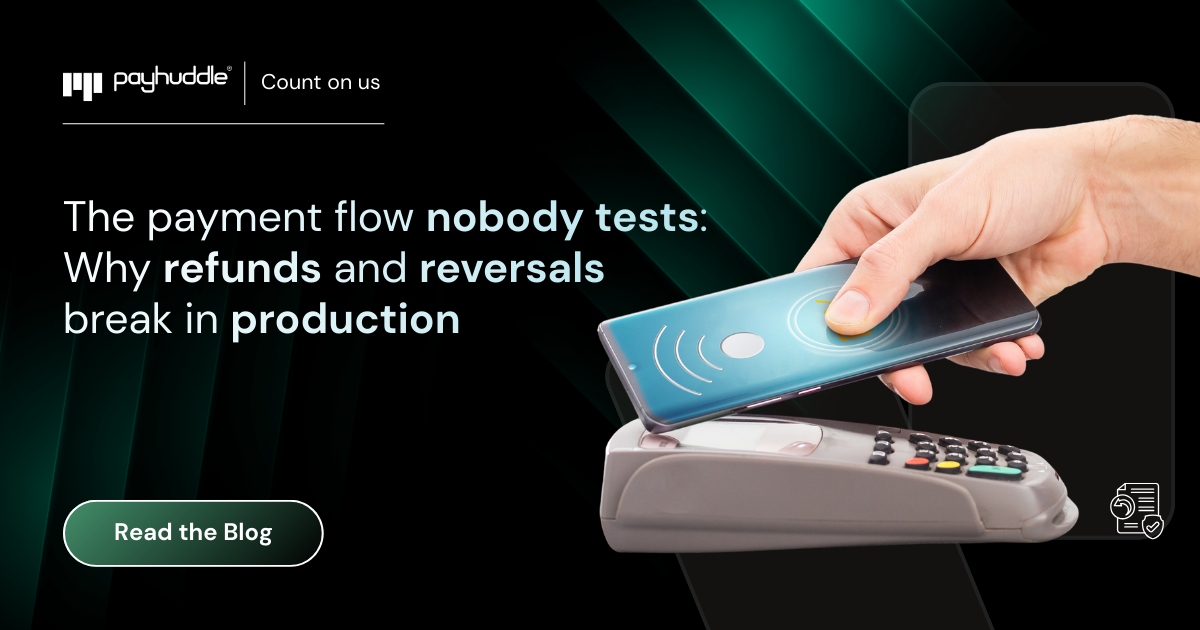
Most payment testing focuses on the moment when a customer taps their card. Did the terminal read the chip correctly? Did the authorization go through? Did the transaction complete?
If those things work, teams usually feel comfortable moving forward. But something interesting happens after a system goes live. The first serious issues rarely come from the purchase flow. They come from everything that happens after the payment.
Refunds. Reversals. Settlement reconciliation.
The parts of the transaction lifecycle that most teams test the least.
Here is a story that stuck with me.
The finance team began to notice discrepancies a few weeks after launching a new payment integration. Customers were requesting refunds. The merchant was processing them. But some refunds were not appearing in the customers' accounts.
At the same time, reconciliation reports revealed unexpected discrepancies among the POS system, the gateway, and the acquirer settlement files.
It took several days to untangle what was happening.
The reason was not the authorization logic but the refund workflow. The system handled standard refunds correctly. However, it behaved differently when a refund occurred after certain settlement conditions were met.
It was an edge case. And no one had tested it.
Payment reversal failure in production rarely occurs on its own. It comes as a discrepancy in a reconciliation report, a customer complaint that arrives days after the transaction, or an unexplained difference between what the POS system recorded and what the acquirer settled. By the time the pattern becomes visible, the issue has usually been present for longer than anyone realized.
Payment systems do not end when authorization succeeds. In many ways, that's just the beginning.
After the purchase, systems still have to handle refunds, reversals, partial refunds, settlement reconciliation, and chargeback handling. These are heavily dependent on how merchants configure their systems. They involve multiple participants, POS systems, gateways, acquiring platforms, settlement processors, and reconciliation tools.
Each one interprets the transaction lifecycle slightly differently. That's where subtle mismatches appear.
EMV refund transaction testing is where those mismatches are supposed to be caught. A refund flow that works correctly in isolation may behave differently when it interacts with a specific settlement window, a partial authorization, or a network timeout that occurred during the original transaction. Payment reversal testing EMV covers these scenarios explicitly, but only if the test plan was designed to include them. In practice, reversal flow payment certification is often scoped narrowly, covering the standard cases and leaving the edge cases for production to discover.
Certification labs rarely test full operational payment lifecycles. Their main focus is on transaction behavior. Mostly verifies whether messages conform to network rules and whether terminals process card data correctly. Operational scenarios such as merchant refund policies/ reconciliation workflows usually fall outside.
Teams typically move forward assuming that if the payment worked, everything else will work too. Most of the time, that assumption holds. But when it does not, the consequences can be messy.
Refund flow EMV certification does not always cover the same ground as a merchant's actual refund policy. A certification lab validates that the refund message is correctly formed and correctly processed by the terminal. It does not validate that the refund behaves correctly in every settlement condition the merchant will encounter in production. That gap is where most post-launch refund issues originate. And because these issues only surface under specific conditions, they can remain undetected across hundreds of transactions before the right combination of circumstances brings them to light.
The worst part of refund problems is that customers usually notice them before anyone else.
They see a charge on their card. They receive confirmation that the refund was processed. But the money never appears.
Now the support team is involved. Then the finance team. Then engineering.
And somewhere along the way, everyone realizes the refund flow was never fully validated before launch. That realization usually arrives a little too late.
The expert testing teams do not stop at authorization but also simulate the full transaction lifecycle with real-time scenarios like:
It shows how systems respond when real operational complexity appears.
EMV adds another dimension to the transaction lifecycle testing approach. It is not enough that a refund was processed. It requires the reconciliation view to check how the refund appears in the settlement file, maps to the original transaction, and flows into the acquirer's reporting, all of which also require validation. A refund that processes correctly but reconciles incorrectly creates a financial discrepancy that may not show until the end-of-day settlement run or during the monthly finance review.
Teams that treat payment reversal testing EMV with the same rigor they apply to authorization testing tend to catch these discrepancies in a controlled environment rather than in production. The test cases are not complicated. They require someone to build them deliberately into the test plan rather than treating reversals and reconciliation as secondary flows.
Running these tests requires a controlled environment where teams can simulate exact scenarios. That's where structured Merchant UAT becomes valuable.
Instead of relying on production transactions to reveal lifecycle issues, teams create controlled test scenarios. They observe how transaction states evolve across systems by simulating refunds and verifying reconciliation.
When refund and reconciliation flows work correctly, customers stop thinking about them.
Sales increase. Refunds get processed faster. Finance teams reconcile their reports without any surprises. Support teams spend less time pulling transaction histories.
None of this is accidental. It usually comes from teams that decided to test operational flows with the same seriousness they applied to authorization.
In the end, payments are not just about accepting money. They are about managing everything that happens afterward.