0

It usually starts with a cardholder noticing something off on their statement. They call their issuing bank, which investigates, and if the transaction is confirmed to be fraudulent, the amount is refunded. The merchant then has to prove the transaction was valid, or the bank takes the money back along with a chargeback fee.
In these situations, the merchant stands to lose the sold products or services, the payment, transaction fee, chargeback transaction fee, and even commissions on currency conversions. Hence, merchants must try to avoid all chargebacks. If a merchant receives too many chargeback requests, they will be labeled as risky, resulting in higher transaction commissions and a 3-month hold on remittances to ensure the safety of customer transactions. Beyond the immediate financial impact, a high chargeback ratio can entirely damage a merchant's relationship with their acquiring bank.
In extreme cases, this can lead to account termination and placement on industry watchlists, such as the MATCH list, making it difficult to secure payment-processing services in the future.
There are many reasons for a chargeback, including fraudulent transactions, credit not processed, item not received, and other technical problems. Since 2015, merchant chargeback liability for EMV has been a real concern in the US. Specifically, merchants who have not migrated to EMV bear liability for chargebacks resulting from fraudulent card-present transactions.
There were major roadblocks to EMV migration, especially in the US, as the acceptance infrastructure was not EMV-certified. Many merchants were caught in a difficult position: the liability shift had taken effect, but the certification process required to deploy EMV-capable terminals had not kept pace with demand.
Merchants who wanted to migrate to chip acceptance could not always do so quickly because their acquirer or terminal vendor had not yet completed the necessary certifications. The result was that merchants bore chargeback liability for fraud they had little direct ability to prevent. Smaller merchants, in particular, found themselves in an especially vulnerable position. They lacked the resources to accelerate certification timelines on their own and were largely dependent on their payment partners to advance the process.
Major card brands like Mastercard, Visa, Amex, and Discover decided to help merchants by streamlining the certification process and implementing chargeback limits to provide relief.
The merchants in the US got breathing space to move to EMV till April 2018, as the payment brands removed the liability shift from merchants for chargebacks under $25 and limited the number of chargebacks to 10 per card account. In addition, these major card brands in the US moved their automatic fuel dispenser EMV activation from October 2017 to October 2020. This extension was particularly significant for fuel retailers, who faced unique hardware and software integration challenges that made their migration path considerably more complex than standard point-of-sale environments.
Card brands have collectively been simplifying the process of EMV terminal testing and certification to speed up the chip migration. The EMV chargeback reduction that followed in markets where migration reached a critical mass was measurable. As more merchants deployed chip-capable terminals, counterfeit card fraud at the point of sale fell, and with it, the volume of fraud-related chargebacks that merchants and acquirers had to manage.
The certification bottleneck that slowed EMV adoption in the US exposed an issue in how the payments ecosystem handles large-scale infrastructure transitions.
Merchants were being held liable for fraud that the very technology they were trying to adopt was designed to prevent. The problem was not an unwillingness to migrate. It was that their acquirers and terminal vendors had not yet cleared the certification hurdles required to deploy chip-capable terminals.
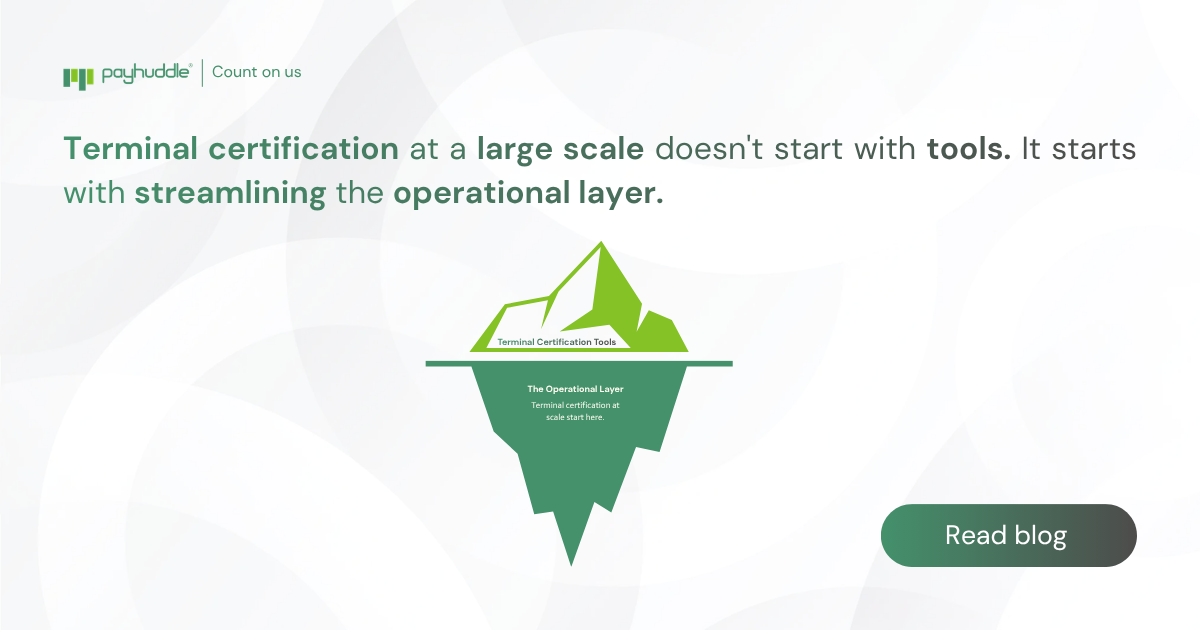
It is why streamlining certification is required beyond just operational efficiency. A week a terminal remains uncertified is another week a merchant absorbs a chargeback they should not have to accumulate.
Acquirers and terminal vendors that move more quickly through certification are simply following compliance guidelines. They are directly reducing the financial exposure their merchant partners face while waiting in the queue.
Fraudulent transactions are not going to go away, but EMV is probably the first step towards eliminating fraud. It would at least keep the not-so-sophisticated fraudsters out of the mix.
Merchants of all sizes must migrate to EMV to reduce fraudulent transactions and eliminate liability for chargebacks. Chargebacks can have a considerable impact on businesses of every size. For small and mid-sized businesses operating on thin margins, even a handful of unresolved chargebacks in a month can meaningfully affect cash flow and operational stability.
Credit card chargeback EMV data from markets that completed migration early clearly support the case. In the UK, where chip and PIN adoption was near-universal well before the US began its migration, counterfeit card fraud at the point of sale dropped sharply after EMV rollout. The fraud did not disappear. It shifted to card-not-present channels, which EMV was never designed to address. But at the physical point of sale, the combination of chip authentication and PIN verification made counterfeit card use considerably harder.
EMV fraud chargeback volumes follow a predictable pattern after migration. In the early stages, chargebacks remain elevated as the mix of chip-capable and magnetic stripe terminals in the market creates inconsistency. As chip acceptance becomes near-universal, the counterfeit fraud that drives most EMV fraud chargebacks at the point of sale falls away, and chargeback volumes in that category decline with it.
Chargebacks are now coming even for EMV transactions, especially in offline mode. It is necessary to substitute or complement EMV to enhance transaction security.
Take the Indian scenario, where there are indigenous home-grown alternatives for EMV transactions. The National Payments Corporation of India (NPCI) and the Indian Government have introduced biometric payments using the unique identity number Aadhaar. Called the Aadhaar Enabled Payment System (AEPS), account-to-account transactions use the remitter's biometric authentication. The possibility of chargeback is absolutely zero in that case.
NPCI has also introduced the revolutionary Unified Payments Interface (UPI), through which money can be transferred via the UPI mobile app or by dialing USSD *99# using a Virtual Payment Address (VPA), a mobile number, a QR code, or an Aadhaar number. Transactions are authenticated using UPI PIN, MPIN, and Aadhaar biometric authentication. The ecosystem has almost zeroed out chargebacks. Even Samsung Pay has launched UPI in India.
The success of these frameworks in India shows that chargeback risk is not an unsolvable problem. It is an engineering and policy challenge that can be addressed when authentication is strong, real-time, and tied to verified identity. Other markets have a clear direction to follow: layering additional authentication on top of EMV, rather than relying on chip technology alone, is where payments security needs to go.
While EMV is a good starting point, it is time for other countries to complement EMV to reduce chargebacks by leveraging biometric or UPI technology.