0
This edition is about a payments problem that most people in the industry have not thought about yet but will.
Electric vehicles are not a future story anymore. They are a present infrastructure story. And like every infrastructure story in payments, the interesting part is not the technology. It is the fragmentation that was built before the standards arrived.
For years, the conversation around EV charging focused on the obvious questions. Where will the chargers go? How fast will they be? Will the grid handle the load?
But there was a quieter problem hiding in plain sight. Every charging network was its own walled garden.
Tata Power had its app. ChargeZone had a different one. Statiq had another. Some networks accepted RFID cards. Some only took the UPI. Some required a pre-loaded wallet. An EV owner travelling across cities might juggle a dozen different apps just to cover their bases. It was the payments equivalent of a world where every petrol pump accepted only one specific card brand, and you had to figure out which one before you left home.
The fragmentation was not a technology failure. It was a standards failure. Every operator built their own payment silo because there was no interoperable standard to build on. The result was a charging experience that added friction at exactly the moment when the industry needed to be removing it.
The Canadian government recently mandated that all public EV chargers support open-loop payments by 2025. Any contactless credit card, debit card, or mobile wallet. No app. No account. No prior registration.
Quebec's Electric Circuit network went further. In mid-2025, they launched Autocharge, a one-time setup through the Electric Circuit app that links a car's unique identifier to the owner's account. After setup, charging starts automatically the moment the car is plugged in. No app open. No card tap. No phone interaction. Plug and go.
The Canadian example is worth paying attention to not because India will follow the same regulatory path, but because it demonstrates what the endpoint looks like. A charging experience that requires no payment thought at all. The infrastructure handles it. The driver handles the driving.
EMVCo is the body that sets the specifications your debit or credit card follows when it works at any ATM or payment terminal anywhere in the world. The same interoperability that makes your card work in Singapore as easily as it works in Mumbai is a consequence of EMVCo standards.
Now EMVCo has extended that same framework to EV charging.
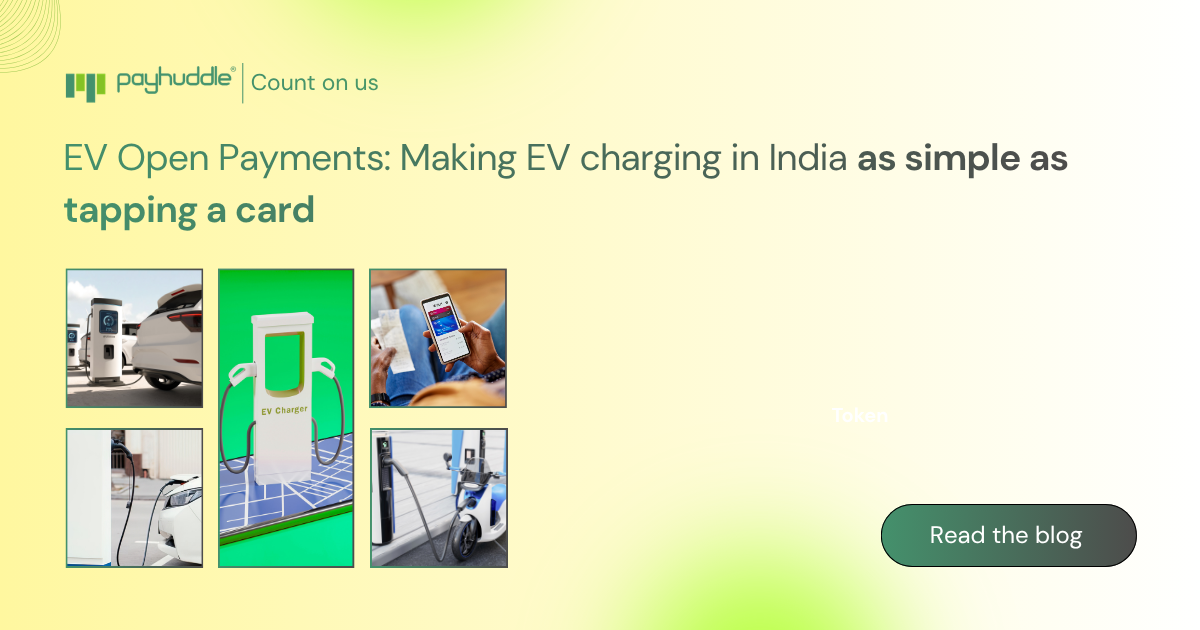
EV Open Payment, or EVOP, is a global standard for paying at EV chargers. It is built on the same EMV specifications that run the world's POS terminals and ATMs. In practical terms, EVOP makes paying at an EV charger as simple as buying a bottle of water at a convenience store. You tap. It works. You leave.
The payments industry spent decades building the infrastructure that makes card acceptance seamless across millions of merchants globally. EVOP extends that infrastructure to a new acceptance category, bringing the interoperability that the payments industry already has to a sector that currently has none.
India's EV payment landscape is fragmented in exactly the way the payments industry was fragmented before interoperable standards arrived.
EVOP changes the fundamental architecture for three groups simultaneously.
For the driver, the change is immediate and visible. No planning ahead. No researching which app works at which network. No pre-loading a wallet before a long trip. Just plug in and charge. The payment happens. The driver does not think about it.
For the charging station operator, the change is structural. Today, operators build and maintain expensive proprietary payment systems just to handle transactions. App development, server maintenance, security updates, account management, customer support for payment failures, all of it is overhead that exists because there is no shared standard to build on. EVOP removes that overhead. The transaction is handled by the open payment infrastructure. The operator focuses on uptime, reliability, and network expansion. That is a meaningfully different business model.
For the payments industry, EVOP is the larger story. India's payments ecosystem is built on interoperability. UPI works across banks. Cards work across ATMs. Aadhaar-linked payments work across institutions. But EV charging has been a holdout, a fragmented market where every network builds its own silo and the consumer carries the cost of that fragmentation. EVOP opens that market to the same interoperable infrastructure that already runs the rest of India's digital payments.
Picture a highway rest stop in 2027.
Four charging stations from three different operators. Each has a payment terminal like the same kind you see at a grocery store checkout.
A delivery driver pulls up. He plugs in. The charge starts. He grabs a tea and comes back. One transaction. No apps. No QR codes. No wallets.
A family from a different city pulls up next. They tap their phone. Same experience. Same two seconds. Different bank. Different network. Same outcome.
The charger does not care who you bank with. It only cares that your payment method is EMV-compliant. And if it is, it works.
Many current charging systems require a pre-loaded wallet tied to a specific network. If you are travelling and do not have that network's wallet loaded, you are stuck, even if the charger is available and the car needs charging.
EVOP removes that constraint entirely. Any compliant payment method works at any EVOP-enabled charger. That increases charger utilisation. Higher utilisation improves the economics for operators. Better economics drives investment in more chargers. The virtuous cycle that the EV charging industry needs to scale runs on interoperability, and interoperability in payments runs on open standards.
The payments industry has been here before. The moment when a fragmented, silo-based ecosystem gets a shared standard is the moment when adoption accelerates.
EMV did it for card acceptance. UPI did it for real-time payments. EVOP is positioned to do it for EV charging.
The teams in the payments industry who understand that transition early, the acquirers, processors, terminal vendors, and payment networks who are thinking about EVOP certification and acceptance infrastructure now, are the ones who will be ready when the mandates arrive and the market opens.
The best payment is one the customer never thinks about. EVOP makes that possible at the charging station. When drivers stop thinking about how to pay, they start thinking about where to go. That is when the EV charging landscape truly changes.