0
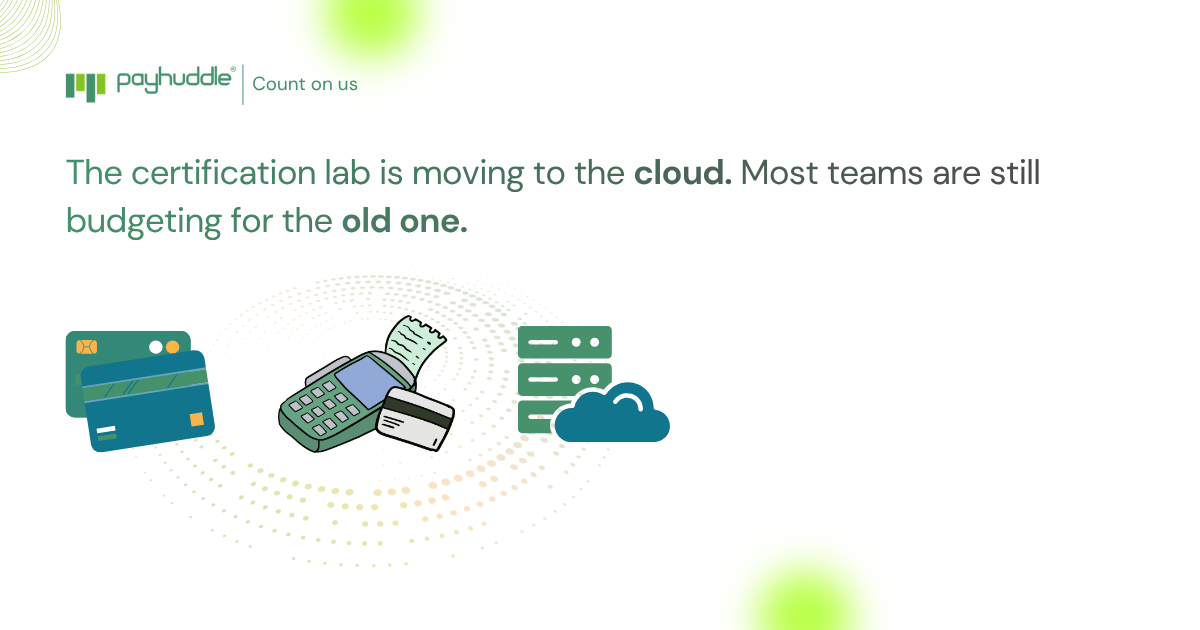
This edition is about a shift that's already well underway, one most certification leads have noticed in passing but haven't fully priced into their plans.
Getting a terminal certified means a physical lab with calibrated hardware and test engineers who understand EMV kernels the way a mechanic understands an engine block.
This setup is now changing.
In-house certification and QA teams have started migrating to third-party service providers offering Testing-as-a-Service (TaaS).
The old model meant owning the problem end to end: terminals, test tools, license management, hardware calibration, and subject-matter experts tracking EMVCo, PCI, and network updates. That drives up fixed costs and scales poorly, because certification volume isn't steady. A big push before launch. Then quiet months where that same infrastructure sits idle.
TaaS flips that into a variable cost. Providers maintain the test environments, the kernels, and the terminals.
Move to TaaS, and you're no longer on the hook for:
If you're only certifying a handful of times a year, this isn't an optimization. It's a completely different cost curve.
Regulatory changes keep increasing.
PCI updates, EMVCo kernel revisions, network mandates, open banking, and new payment rails add layers, creating new certification needs on top of the previous ones.
Every revision can trigger a fresh round of terminal, host, or CPV re-testing.
Certification volume is not even. As a terminal vendor, you might certify a few new models each year, then re-certify existing ones against firmware patches and mandated updates. This changing demand is exactly what elastic, SLA-backed TaaS capacity is built for.
And the providers now genuinely exist. Specialist labs with EMVCo and network accreditation offer remote, cloud-hosted testing across the full certification lifecycle, without you managing any underlying infrastructure.
"Payment certification" gets used as if it's a single thing. It isn't.
Terminal certification, at L3, is network-specific. It validates end-to-end transaction flows: authorization, decline, referral, reversal, partial approval, and offline handling, against each network's own test suite. L3 sits above L1 and L2, which EMVCo governs; a terminal has to clear both before it's even eligible for L3.
The challenges here are less about L1 and L2 and more about the compliance guidelines. Every network has its own test-case set, versioning, and regulatory re-certification requirements. Whether it's a kernel update, a new product variant, or a change in host connection, any of these can send a terminal back through L3.
Next comes host certification, at the other end. It validates acquirer/processor host message flows, responses, and settlement. It's less about hardware and more about message-protocol conformance, like ISO 8583, and that's exactly why it maps so cleanly onto cloud-hosted TaaS: simulated terminal traffic against a host, no physical devices required.
The third layer is card personalization validation, or CPV, and it's easy to lump in with terminal testing, but it belongs to a different part of the ecosystem entirely. CPV verifies what's written onto an issued card's chip, not what a terminal does with it: the PAN, keys, and application data a personalization bureau programs must conform to network specs before the card is fit to ship. It's specialist, infrequent work, mostly relevant to issuers and personalization bureaus rather than terminal vendors, which is exactly why most of them don't want to build the expertise in-house for something they run only a handful of times a year.
What used to be three separate procurement conversations- a terminal lab, a host environment, a card-personalization specialist- is consolidating under fewer, broader TaaS providers. That matters most for the organizations that touch more than one of these: a bank that both issues cards and acquires transactions, for instance, no longer needs three separate vendor relationships to cover terminal, host, and card-side certification. It can run all three through one.
That's a real simplification. It also raises the stakes on who you pick. A provider needs genuine depth across all three, not a terminal lab with a host-testing feature bolted on.
Terminals get shipped to the provider's accredited lab instead of your own test lab.
Test cases get configured, runs get scheduled, and reports get pulled through a web platform. The lab handles physical interfacing; you handle remote orchestration.
Host testing goes simulator-first. CPV becomes an on-demand engagement, tapped exactly when a chip application needs verifying, instead of a capability staffed year-round.
Certification stops being a project. It becomes a service, with ongoing re-validation as firmware and software releases roll out.
Internal QA doesn't close completely. It gets specialized: domain expertise and product functionality stay in-house, while infrastructure-heavy, repeatable execution moves out.
TaaS looks compelling on cost and speed. But payments is exactly the domain where execution and control need to stay close.
Running an EMV L3 test script is an execution skill. Deciding how an ambiguous test case applies to a specific kernel configuration, or how to interpret a network's mandate letter, is subject-matter expertise. That category still needs deep, retained institutional knowledge. A passed test suite doesn't automatically mean the interchange or liability-shift implications have been thought through.
The providers gaining real traction understand that line. They position themselves as an extension of your certification function, flagging judgment calls back to you rather than operating as a black box that returns a pass or fail.
Expect more certification bodies and terminal vendors to lean on hosted, remote infrastructure across terminal, host, and CPV testing over the next few cycles.
The leaders won't be the teams that outsource everything. They'll be the ones who use TaaS to free their best domain expertise for the judgment calls that actually need it.