0
In the payments ecosystem, certification is often mistaken for readiness.
A merchant completes POS/ATM certification, gateway certification, and acquirer sign-off, and assumes the system is production-ready.
But many production failures do not come from protocol non-compliance.
They come from merchant-specific configuration, real-world usage, and operational flows, areas that certification testing does not cover.
It is where Merchant UAT becomes critical.
Most merchants believe that once certification is complete, they are ready to go live.
But that is not the case every time.
Certification confirms compliance with payment brand and protocol requirements in a controlled environment.
What it does not confirm is whether payments will work correctly in a merchant's actual setup, across stores, gateways, networks, and operational workflows.
As a result, merchants often go live with:
These issues do not appear in certification labs but occur at merchants' checkout counters, during peak hours, in front of customers.
When Merchant UAT gets avoided, failures move directly into production:
Each issue leads to customer dissatisfaction, operational escalation, and loss of trust, all on top of having certification.
Merchants do not fail because they were not compliant.
They fail because they were not ready for real-world challenges.
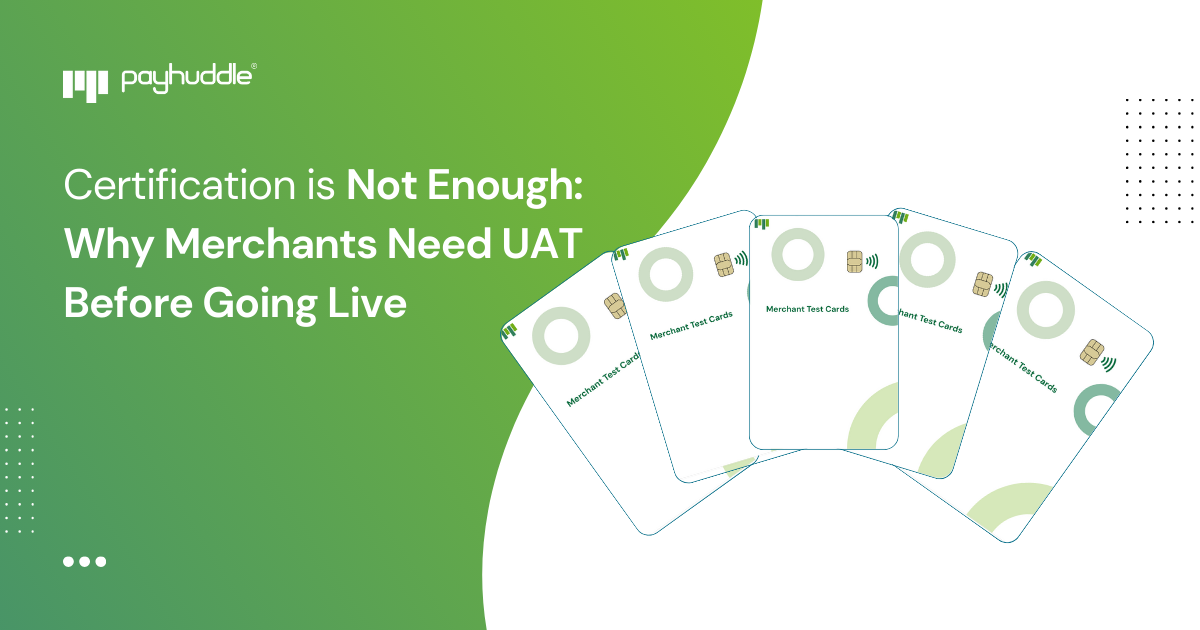
PayHuddle's Merchant UAT Test Cards are designed to validate what certification does not, which is real-world merchant readiness.
Here is how merchants can use Payhuddle Merchant UAT test cards during the early pre-certification stage or after completing the EMV Level 3 terminal integration certification:
PayHuddle's Merchant UAT test cards replicate how transactions behave in real merchant environments.
What merchants get from merchant test cards:
Instead of reacting to failures in production, teams could resolve them upfront.
Merchants that perform UAT using our UAT test cards:
Certification proves you meet the rules.
Merchant UAT proves your business is ready for the real world.
With PayHuddle, merchants do not discover payment issues at the checkout counter.
Merchants avoid them before going live and before customers ever see them.