0
In this blog we turn to Tropo, our card personalization validation tool, and a question bureaus and issuers rarely ask: what does testing look like on the days when nobody is certifying anything?
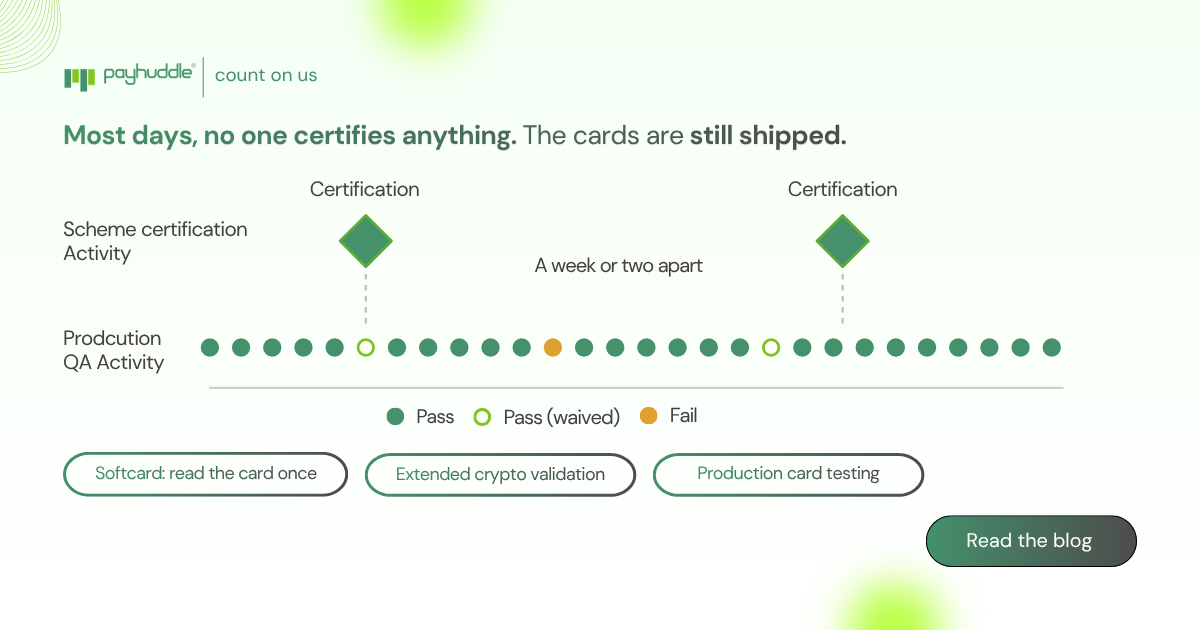
A personalization bureau goes through formal scheme certification once or twice a month. The rest of the time, it does something just as important: checking the cards it produces.
Picture a test engineer at the end of a production run. They take a handful of cards from the day's output, from however many banks were personalized that day, and make sure each one is right before it leaves the building.
That isn't about certification. Certification is a tag-by-tag validation exercise. Daily checks are about volume: many cards and banks, and an answer to validate. Tropo already handles the first thing. Three updates now cover the second, plus two questions bureaus keep running into: shipping, and whether the security values on a card are actually right.
Cards travel. A bureau personalizes a batch of cards, ships samples to the issuer, and the issuer sends them to a testing lab. Each step risks damaging or losing a card.
Softcard cuts it short. An engineer inserts the card once, and Tropo’s CRT reader reads contact, contactless, and magstripe in a single pass. It shows every application on the card and captures the full data for each one.
Then Tropo does the comparing: applications from the same scheme, applications from different schemes, and repeated transactions on the same application. Inconsistencies show up without anyone holding the physical card, and the capture can be exported and reused for project validation. Once a card is captured as a Softcard, it doesn't have to ship again for that testing cycle.
Certification confirms that a card's security data is present and follows the scheme's guidelines. That's what it's built to do. But it doesn't always prove the values themselves are right, and depending on the scheme, some of the card's dynamic security behavior may never be exercised.
A misconfigured key, a wrong derivation method, or a broken issuer command will not come to light until user acceptance testing (UAT), or until the card is already with a cardholder. By this time, tracing the problem costs more.
Extended Crypto Validation works through the full chain on every card, before issuance. It checks that the security values the card produces are correct, that its transaction counters behave as expected, and that it responds properly to the issuer. It also verifies that issuer commands like blocking, unblocking, and changing a PIN work. For cards with several applications, results are broken out per application, and it includes the Mastercard dynamic check from Mastercard's own CPV test plan.
The aim is simple: find and fix the defect at the bureau, before the card gets anywhere near UAT.
The production update changes how a bureau uses Tropo every day. It's built around how engineers actually work: one person, one card at a time, across many banks.
The engineer scans the first card. Tropo identifies the bank and loads its setup. The next several cards come from the same bank, and each shows a pass or a fail.
One fails. The engineer opens its card report, sees the exact test case and criteria, and flags the batch. Then a card arrives from a bank Tropo hasn't seen. A prompt appears, offering to onboard it. At the end of the session, the report shows results for each bank, including how many waivers carried over from certification.
These updates don’t change anything in formal scheme certification. Production card testing is a workflow for the days between, and the schemes still make their own certification decisions. Softcard saves shipping, but it depends on reading the card once, so a physical card is still needed for that first capture. And any validation is only as good as the profile and key material the team loads.
Tropo currently meets the Mastercard Personalization Validation Tool 2.0 requirements and the Visa Global Self-Service Option Validation Framework, and these updates work alongside them.
Most bureau testing happens on ordinary days, not on certification day. A tool built only for the big occasions leaves the everyday work to spreadsheets and memory. We want the daily check to get the same care as the milestone.